

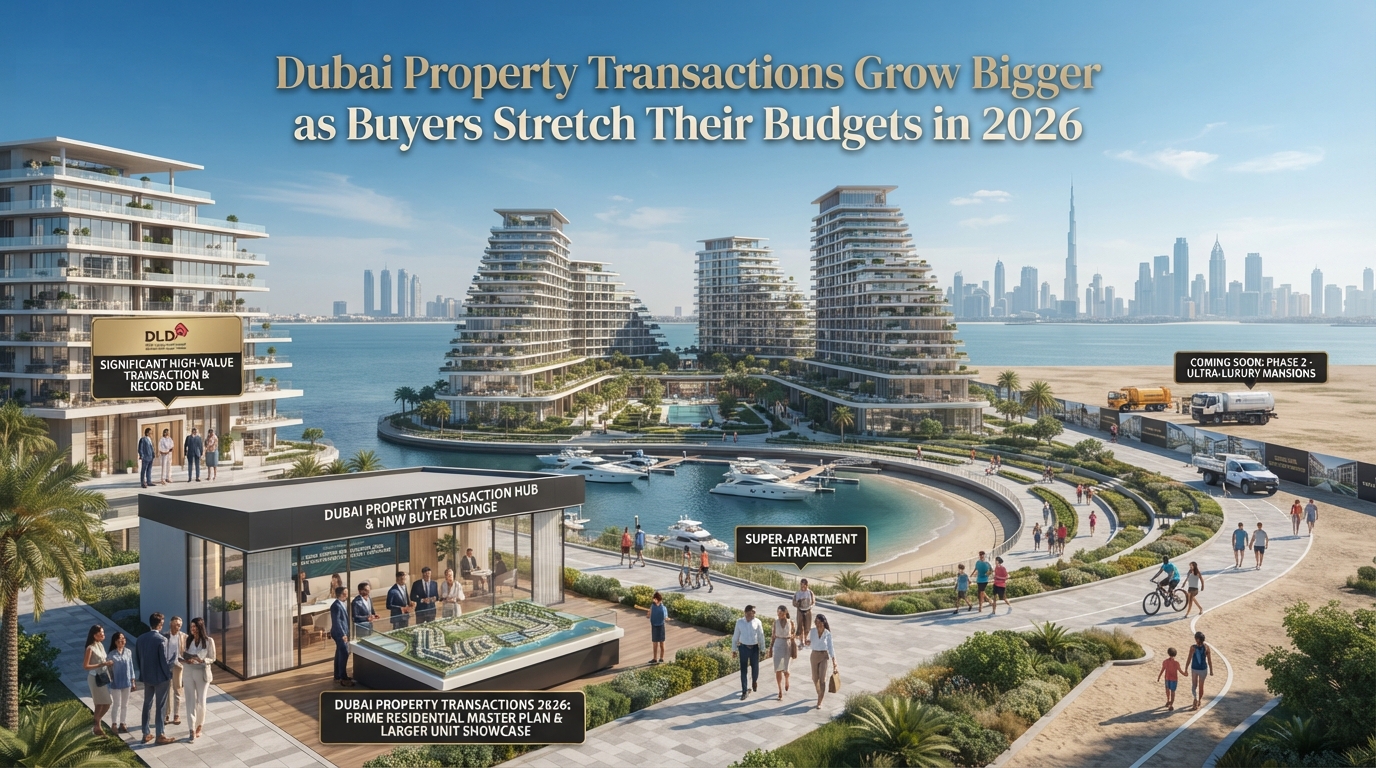

Dubai Property Transactions Grow Bigger as Buyers Stretch Their Budgets in 2026
Dubai’s property market is seeing an interesting change in buyer behaviour in 2026: some purchasers are increasing the amount they are prepared to spend, even as the market becomes more selective. For anyone following Dubai propertzone real estate, the shift is particularly visible in the mid-market, where buyers are increasingly considering properties around the AED 1 million to AED 2 million range.
Recent industry commentary indicates that flexible developer payment plans and softer pricing have given some buyers greater room to increase their budgets. Industry executives have also reported a shift from compact studios towards one-bedroom and larger homes.
Buyers Are Increasing Their Property Budgets
One of the clearest changes being discussed across Dubai’s residential market is the increase in average transaction ticket sizes.
Tauseef Khan, founder and chairman of Dugasta Properties, told Khaleej Times that average spending among his company’s mid-market buyers had increased from around AED 600,000 to AED 950,000, with many transactions moving into the AED 1 million to AED 2 million range.
The change is important because it suggests that some buyers are no longer looking exclusively for the lowest entry price.
Instead, they are asking whether spending more can provide a better location, larger layout, stronger amenities, improved usability or potentially broader rental appeal.
That does not mean every buyer is increasing their budget. Rather, the market is becoming more segmented, with active buyers becoming more selective about where they allocate their available capital.
Why Are Buyers Spending More?
Several factors are contributing to the change.
The first is the availability of more flexible developer payment plans. Instead of requiring the full purchase amount within a short period, some developers are structuring payments over longer periods.
This can make a higher-priced property easier to manage from a cash-flow perspective.
The second factor is pricing.
Recent industry reporting has described softer pricing in parts of the market, allowing buyers who were previously considering one price bracket to explore properties slightly higher up the market.
The third factor is changing buyer preferences.
Some purchasers are choosing to spend more because they want a property that better fits their lifestyle or investment objectives.
The AED 1 Million to AED 2 Million Segment
The AED 1 million to AED 2 million range has become an increasingly discussed part of Dubai’s residential market.
The National reported in September 2026 that buyers were shifting towards this bracket while appetite for some ultra-luxury properties was becoming more selective.
This segment sits between entry-level residential property and Dubai’s ultra-luxury market.
It can include one-bedroom apartments, larger apartments, selected townhouses and properties in developing communities, depending on location and project.
For buyers, the segment provides an opportunity to balance purchase price against property size, location and expected usability.
From Studios to One-Bedroom Apartments
Another notable change is the movement from compact studios towards one-bedroom and larger configurations.
According to industry commentary reported by Khaleej Times, buyers are increasingly considering larger layouts for reasons including potential rental yield.
The decision is not necessarily about space alone.
A one-bedroom apartment can appeal to a broader tenant group than a studio in some communities, while larger layouts can also provide additional flexibility for owner-occupiers.
However, the relationship between unit size and rental performance varies by location. Buyers should compare actual transaction and rental data for the specific community rather than assuming a larger property will automatically produce a better return.
Flexible Payment Plans Are Changing How Buyers Think About Budgets
Payment plans are an important part of Dubai’s off-plan market.
Consider a simplified example.
A buyer has AED 250,000 available today. A property priced at AED 750,000 may initially appear more achievable than a property priced at AED 1 million.
However, if the AED 1 million property has a developer payment structure that spreads instalments across construction and post-handover periods, the buyer may be able to consider it.
The property has not become cheaper.
The payment timing has changed.
This distinction is essential when assessing affordability.
A flexible payment plan can improve cash-flow management, but buyers still need to calculate the complete purchase price, future instalments, financing requirements and ownership costs.
Bigger Transactions Do Not Mean Every Segment Is Rising
The increase in transaction values should not be interpreted as evidence that every part of Dubai’s market is moving in the same direction.
Dubai’s property market consists of many different micro-markets.
A premium waterfront apartment, a Jumeirah Village Circle studio, a Dubai Hills villa and an off-plan townhouse in an emerging community can have very different demand patterns.
Betterhomes recently described Dubai as increasingly behaving like a collection of distinct micro-markets, with buyers scrutinising value more closely and stronger properties continuing to transact.
That makes location-level research increasingly important.
Buyers Are Becoming More Selective
Higher transaction values are occurring alongside more selective purchasing behaviour.
Betterhomes reported that Dubai Land Department data for August showed the average value per transaction across combined apartment and villa sales increasing 7% month-on-month, while average apartment prices increased 4%.
At the same time, the number of buyers completing transactions was lower.
This creates an important distinction between transaction volume and transaction value.
A market can have fewer transactions while the buyers who remain active spend more on individual properties.
For property investors, looking at both measurements provides more context than relying on transaction volume alone.
What Are Buyers Actually Paying More For?
Higher budgets do not necessarily mean buyers are simply purchasing more square footage.
In many cases, the additional spending can be directed towards attributes such as:
- Better location
- Improved connectivity
- Larger layouts
- Better building facilities
- Higher construction quality
- Recognised developers
- Community amenities
- Stronger rental appeal
- Better views
- More practical floor plans
This changes the way buyers should evaluate properties.
Instead of asking only, “How much property can I buy?”, a more useful question is, “What additional value do I receive for the additional amount I spend?”
Mid-Market Buyers Are Becoming More Important
The growing interest in the AED 1 million to AED 2 million bracket highlights the importance of Dubai’s middle segment.
This market can include UAE residents, expatriate professionals, families and investors looking for a balance between affordability and property quality.
For developers, this creates an opportunity to design products around practical layouts, accessible payment structures and community amenities.
For buyers, it creates more choice between smaller entry-level properties and premium luxury homes.
What Does This Mean for Investors?
Investors should be careful about interpreting rising ticket sizes as an automatic investment signal.
A higher purchase price can provide access to a better property, but it also increases the amount of capital at risk.
Before increasing a budget, investors should compare:
Purchase price → Rental income → Service charges → Financing cost → Expected liquidity
For example, paying AED 1.4 million instead of AED 900,000 should only make sense if the additional AED 500,000 provides a sufficiently compelling combination of property quality, rental potential, location and long-term usability for that particular investor.
The answer will differ from one property to another.
What Does This Mean for End Users?
Owner-occupiers may have a different reason for increasing their budgets.
A buyer may move from a studio to a one-bedroom apartment because they need:
- More living space
- A separate bedroom
- Better storage
- A more practical layout
- Greater privacy
- A property suitable for future use
For these buyers, rental yield may be less important than lifestyle and long-term usability.
This is why property decisions should be based on the buyer’s actual objective rather than a single market trend.
Dubai’s Property Market Is Becoming More Data-Driven
As buyer budgets become more flexible and the market becomes more segmented, broad city-wide averages can provide only part of the picture.
Recent Dubai transaction data illustrates how different budget brackets correspond to different property sizes and communities. Data through September 2026, for example, shows that the AED 750,000–AED 1.5 million bracket represented a substantial share of registered home sales over the preceding 12 months.
For buyers, this reinforces the importance of looking at actual completed transactions rather than relying exclusively on asking prices.
A property’s advertised price tells you what a seller or developer wants.
A registered transaction tells you what a buyer actually paid.
Payment Plan vs Purchase Price
One of the biggest mistakes buyers can make is confusing affordability with payment flexibility.
Suppose two properties are both advertised with manageable monthly instalments.
Property A costs AED 900,000.
Property B costs AED 1.2 million but offers a longer payment schedule.
Property B may appear easier to purchase on a monthly basis, but it remains the more expensive property.
Before choosing, buyers should calculate:
- Total purchase price
- Initial payment
- Subsequent instalments
- Handover payment
- Post-handover payments
- Registration costs
- Service charges
- Mortgage costs where applicable
The complete financial commitment matters more than the size of the monthly instalment alone.
What Should Buyers Look for in 2026?
With buyers becoming more selective, several factors deserve particular attention.
Location
Look at connectivity, infrastructure, schools, employment centres, retail and future development.
Developer
Review the developer’s delivery history, project quality and existing communities.
Property Layout
Compare usable space rather than relying only on the headline square footage.
Payment Plan
Understand exactly when every instalment becomes due.
Service Charges
A lower purchase price can be offset by higher recurring ownership costs.
Rental Demand
Investors should study actual rents and tenant demand in the specific building or community.
Future Supply
Consider how many competing properties are expected to enter the market.
Exit Liquidity
Think about who the likely future buyer will be if you decide to sell.
Is a Bigger Budget Always Better?
Not necessarily.
Increasing a property budget can open access to more choices, but it does not automatically produce a better investment or a more suitable home.
A buyer with AED 1.5 million available could potentially choose:
- One premium apartment
- Two smaller investment units, depending on financing and transaction costs
- A townhouse in an emerging community
- A larger apartment in a more established location
Each option has a different risk, cost and usage profile.
The correct comparison should therefore focus on the property’s fundamentals rather than simply its price.
Dubai Property Transactions and Market Liquidity
Liquidity is another Dubai property buyers important part of the equation.
A property with a large potential buyer pool may be easier to sell than a highly specialised property with a narrow audience.
This does not mean lower-priced properties are automatically more liquid.
Factors such as location, developer, building quality, unit size, pricing and current supply can all influence resale activity.
Buyers increasing their budgets should therefore consider the eventual exit strategy as carefully as the initial purchase.
The Role of Dubai’s Off-Plan Market
Flexible payment plans are particularly relevant to Dubai’s off-plan sector.
Off-plan developments can offer structured instalments that differ from the financing requirements of completed properties.
For buyers, this can provide greater flexibility in managing capital during construction.
However, off-plan purchases also require attention to:
- Construction timeline
- Developer track record
- Escrow arrangements
- SPA terms
- Payment milestones
- Expected handover
- Future competing supply
- Service-charge expectations
A payment plan should complement sound property fundamentals rather than replace them.
A Practical Budget Framework for Dubai Buyers
Before increasing your property budget, consider using a simple framework:
Step 1 — Establish available cash
Determine the amount you can comfortably allocate without exhausting your reserves.
Step 2 — Calculate the complete acquisition cost
Include registration, agency, financing and other transaction expenses where applicable.
Step 3 — Establish your comfortable monthly commitment
Do not base the decision solely on the maximum amount a bank or developer allows.
Step 4 — Compare several property types
Consider apartments, villas and townhouses according to your objectives.
Step 5 — Compare communities
Analyse actual prices, rents, supply and infrastructure.
Step 6 — Test the exit strategy
Consider who would buy or rent the property in the future.
Final Thoughts
Dubai’s property market in 2026 is showing a more nuanced pattern than a simple rise or fall in demand.
Industry executives have reported that some mid-market buyers are increasing their average spending, with transactions increasingly moving into the AED 1 million to AED 2 million range. Flexible developer payment plans are helping some buyers access properties that previously sat outside their immediate budgets.
At the same time, buyers are becoming more selective and increasingly focused on the quality, location, layout and potential usability of individual properties.
For anyone researching Dubai property, the key lesson is to separate budget flexibility from actual affordability.
A larger budget can create access to better properties, but the additional spending should be evaluated against the property’s price, rental potential, ownership costs, location, future supply and resale liquidity.
In a market increasingly shaped by different micro-markets, the strongest analysis starts with the individual property and community rather than the headline city-wide trend.
Frequently Asked Questions
Are Dubai property buyers spending more in 2026?
Industry executives have reported increasing average ticket sizes among some mid-market buyers, with more transactions moving into the AED 1 million to AED 2 million range.
Why are buyers increasing their budgets?
Reported factors include softer pricing, flexible developer payment plans and a preference for larger or better-positioned properties.
Are buyers moving from studios to one-bedroom apartments?
Industry commentary indicates that some buyers are shifting towards one-bedroom and larger configurations, partly because of perceived rental and usability benefits.
Is AED 1 million to AED 2 million a popular Dubai property range?
Recent industry reporting has identified this bracket as an increasingly important segment of Dubai’s residential market in 2026.
Do flexible payment plans make property cheaper?
No. A payment plan changes the timing of payments rather than necessarily reducing the property’s total purchase price.
Should I increase my property budget?
That depends on your financial position, objectives and the specific property. A higher budget should be assessed against the property’s complete cost and expected use or investment characteristics.
What should investors compare before spending more?
Investors should compare purchase price, rental income, service charges, financing costs, future supply, location and potential resale liquidity.
Is Dubai’s property market moving in one direction?
Not necessarily. Current reporting indicates different segments and communities are experiencing different levels of demand and pricing activity, making micro-market analysis increasingly important.
What is more important: property price or payment plan?
Both matter, but buyers should first understand the total purchase cost and then assess whether the payment schedule fits their cash flow.
Where can buyers find actual transaction information?
Dubai Land Department data and registered transaction databases can provide information about completed transactions. Buyers should distinguish actual transaction prices from advertised asking prices.