

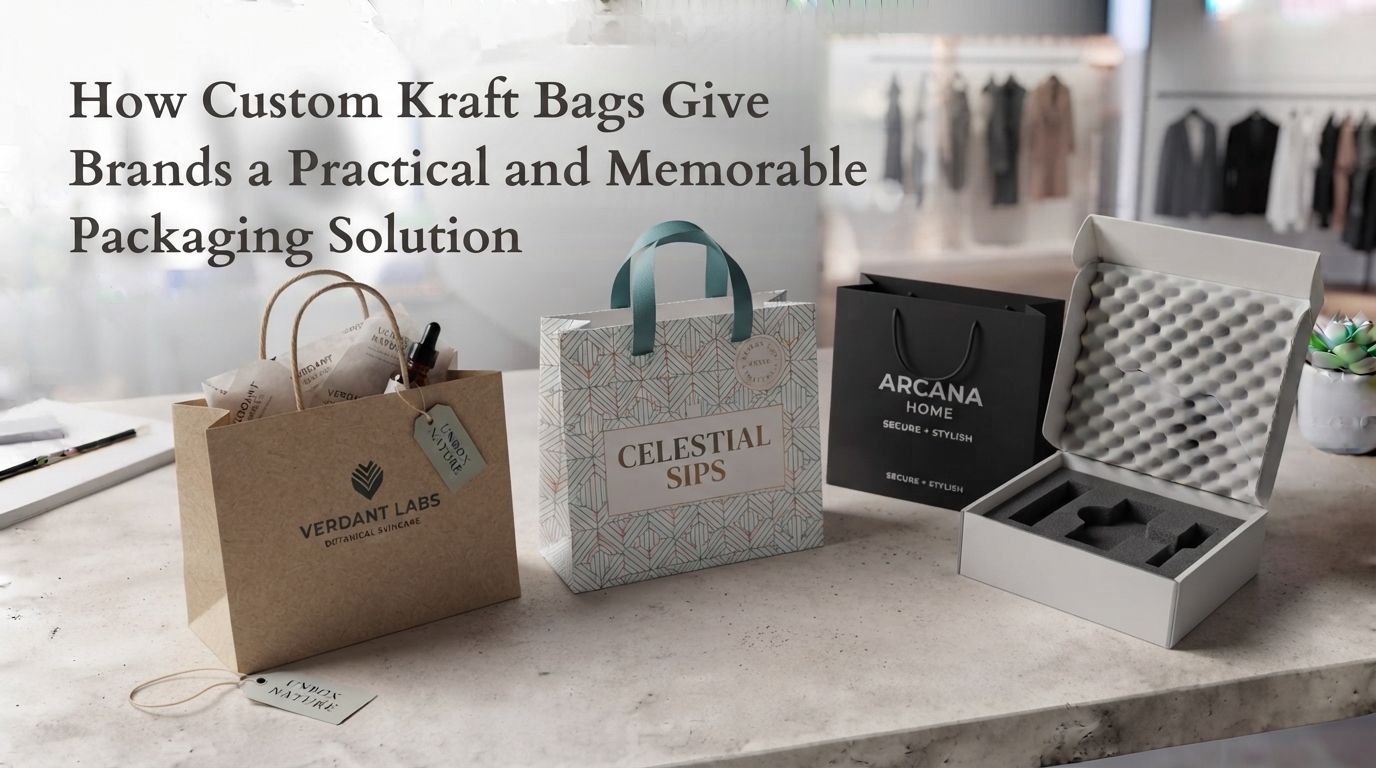

How Custom Kraft Bags Give Brands a Practical and Memorable Packaging Solution
Packaging is one of the most visible ways a business communicates with customers. From the moment a customer receives a purchase, the packaging can influence how the brand is perceived.

For retailers, fashion companies, boutiques, restaurants, gift businesses, beauty brands, and ecommerce sellers, a well-designed bag can combine practical carrying functionality with recognizable branding. Kraft bags are particularly useful for businesses looking for a versatile packaging format that can be adapted to different products and brand identities.
A coordinated packaging strategy built around Branded Packaging Boxes can also help businesses connect bags with boxes, inserts, labels, and other customer-facing packaging elements.
Why Custom Kraft Bags Matter
A plain shopping bag may perform its basic function, but customized packaging can contribute much more to the customer experience.
Branding transforms a simple carrying bag into a visible part of the business identity.
Custom kraft bags can help brands:
- Display their logo and visual identity
- Create a consistent retail experience
- Improve product presentation
- Support gifting and promotional activities
- Provide a practical carrying solution
- Complement branded boxes
- Increase brand visibility outside the store
The effectiveness of the bag depends on how well its dimensions, construction, artwork, handles, and intended use are planned.
What Makes Kraft Bags Versatile?
Kraft packaging can work across a wide range of industries and applications.
Retail businesses may use bags for clothing, accessories, gifts, cosmetics, food products, or other merchandise. A business can develop different sizes or artwork variations depending on its product range.
For example, a boutique may require a larger bag for folded apparel, while a jewelry retailer may need a smaller format.
The packaging should therefore be developed around actual products and typical customer purchases.
Choosing the Right Bag Size
Dimensions are one of the most important aspects of bag planning.
Before selecting a size, businesses should consider:
- Product dimensions
- Product quantity
- Product weight
- Product shape
- Protective wrapping
- Tissue paper
- Inserts
- Handle placement
- Storage requirements
A bag that is too small can make packing difficult, while an unnecessarily large bag may use more material and create an inefficient presentation.
The best size usually comes from understanding how the completed purchase will be arranged inside the bag.
Custom Kraft Bags for Fashion Retail
Fashion businesses can use branded bags as part of the complete customer journey.
A customer purchasing a shirt, sweater, dress, accessory, or other garment may receive the product in a branded bag after checkout.
The bag can reinforce the visual identity established by:
- Clothing labels
- Garment tags
- Product packaging
- Store displays
- Website design
- Social media content
Fashion businesses can also coordinate their bags with custom garment boxes to create a more unified packaging system.
For premium clothing purchases, the bag can become an important part of the presentation rather than simply being used for transportation.
Creating a Strong Brand Identity
A kraft bag provides a physical surface where businesses can communicate their identity.
Branding options may include:
- Logo
- Brand name
- Typography
- Brand colors
- Patterns
- Illustrations
- Taglines
- Website information
- Promotional messages
A simple logo can create a clean appearance, while a repeating pattern can make the bag more distinctive.
The design should be consistent with the company’s other packaging and marketing materials.
Printed Kraft Bags for Retail Businesses
Printing gives businesses flexibility when creating recognizable packaging.
A brand can use the bag to reinforce its visual identity every time a customer leaves a store carrying a purchase.
For example, a retailer might use:
Logo + brand colors + simple typography
Another business might prefer:
Pattern + logo + promotional message
Neither approach is automatically better. The right choice depends on the brand’s identity and customer base.
The most important consideration is maintaining visual clarity.
Using Kraft Bags for Gift Packaging
Kraft bags can also be incorporated into gifting experiences.
Retailers can use branded bags for:
- Birthday gifts
- Holiday purchases
- Wedding gifts
- Corporate gifts
- Seasonal promotions
- Special events
- Customer appreciation campaigns
Additional elements such as tissue paper, stickers, ribbons, or cards can be coordinated with the bag.
This creates an opportunity to make even a relatively simple purchase feel more considered.
Custom Kraft Bags for Beauty Brands
Beauty and personal-care businesses often have multiple small products that customers may purchase together.
A suitably sized kraft bag can accommodate products such as:
- Skincare
- Cosmetics
- Haircare
- Fragrance
- Beauty accessories
- Gift sets
The bag size should reflect the typical purchase combination.
A bag designed for a single compact product will have different requirements from one intended to hold several boxed products.
Beauty brands can also coordinate bag artwork with their product packaging to create stronger visual consistency.
Supporting a Premium Packaging Experience
Kraft does not have to mean basic.
With thoughtful design, appropriate proportions, refined branding, and suitable finishing, kraft packaging can support a premium presentation.
The overall effect can be influenced by:
- Bag proportions
- Logo placement
- Typography
- Handle selection
- Print treatment
- Interior presentation
- Product arrangement
A restrained design can sometimes communicate quality more effectively than excessive decoration.
For brands with a luxury positioning, packaging should reflect the same design language used throughout the customer experience.
Kraft Bags for Events and Promotions
Businesses can also use customized bags for events and marketing campaigns.
Common applications include:
- Trade shows
- Product launches
- Conferences
- Pop-up shops
- Fashion events
- Corporate events
- Promotional campaigns
A branded bag can hold brochures, samples, merchandise, promotional materials, or other event items.
Because customers may carry these bags throughout an event or afterward, they can also provide additional opportunities for brand visibility.
Choosing Appropriate Handles
The handle is both a functional and visual component of a bag.
Businesses should consider the intended product weight and carrying conditions when selecting a handle style.
Other factors include:
- Bag dimensions
- Brand positioning
- Customer comfort
- Handle attachment
- Overall appearance
A handle that looks appropriate for a lightweight gift bag may not be suitable for a heavier retail purchase.
Planning the handle together with the rest of the bag specification can produce a more balanced result.
Kraft Bags and Ecommerce
Kraft bags are most commonly associated with retail, but ecommerce brands can also use them in selected situations.
For example, they may be useful for:
- Local deliveries
- Click-and-collect orders
- Event purchases
- Gift orders
- Boutique fulfillment
- In-person customer pickups
For standard parcel shipping, a kraft shopping bag should not automatically replace protective shipping packaging.
Instead, businesses should consider whether the bag is serving a presentation function, while an outer shipping package provides the protection needed during transportation.
Coordinating Bags With Clothing Packaging
Packaging becomes more effective when individual components work together.
A fashion brand might coordinate:
- Kraft bags
- Clothing boxes
- Tissue paper
- Hang tags
- Stickers
- Product cards
The same logo, typography, colors, and graphic elements can be repeated across these materials.
This creates a consistent visual system that customers can recognize.
The bag does not have to duplicate the box exactly. Instead, both can share recognizable brand elements while serving different functions.
Common Custom Kraft Bag Mistakes
Selecting the Bag Before Measuring Products
The bag should be sized around the actual products and expected purchase configuration.
Ignoring Product Weight
Weight can affect handle selection and overall bag requirements.
Overcomplicating the Artwork
Too many elements can make the branding difficult to read.
Forgetting the Interior Presentation
The customer’s experience continues after the bag is opened or the products are removed.
Using the Same Size for Every Product
Different product categories may require different bag dimensions.
Ignoring Storage
Businesses should consider how empty bags will be stored before being distributed to customers.
How to Plan Custom Kraft Bags
A practical planning process can help businesses create packaging that fits their needs.
1. Identify the products.
Determine which products customers will typically carry in the bags.
2. Measure the products.
Consider width, height, depth, and the final wrapped or boxed configuration.
3. Estimate typical purchase weight.
Consider both standard and heavier purchase combinations.
4. Determine bag dimensions.
Choose proportions that accommodate products without excessive empty space.
5. Select the handle approach.
Choose a style appropriate for the bag’s intended use and weight.
6. Develop the artwork.
Position the logo, colors, typography, and other visual elements appropriately.
7. Coordinate with existing packaging.
Match important visual elements with boxes, labels, tissue, and other materials.
8. Consider the sales channel.
Determine whether the bag will be used in-store, for events, local delivery, or another application.
9. Review storage requirements.
Plan where and how empty bags will be stored.
10. Confirm the final specification.
Review dimensions, construction, artwork, and finishing before production.
Why Customization Can Make a Difference
Customization gives a business greater control over the relationship between packaging and brand identity.
Instead of using generic bags, businesses can create packaging around their:
- Product range
- Brand personality
- Target audience
- Retail environment
- Customer experience
- Marketing strategy
This can be particularly useful for businesses where packaging remains visible after the purchase.
A customer carrying a branded bag becomes part of a physical brand interaction that extends beyond the checkout counter.
Frequently Asked Questions
1. What are custom kraft bags used for?
Custom kraft bags are commonly used for retail purchases, gifting, events, promotions, local delivery, and other applications where businesses need a branded carrying solution.
2. Can kraft bags be printed with a logo?
Yes. Businesses can incorporate logos, brand names, colors, patterns, typography, and other artwork into the bag design.
3. How do I choose the right kraft bag size?
Start with the products that will normally be placed inside. Consider their combined dimensions, quantity, weight, protective materials, and any boxes or inserts.
4. Are kraft bags suitable for clothing brands?
Yes. Clothing retailers and fashion brands can use kraft bags for garments and accessories, particularly when the bags are coordinated with their broader apparel packaging.
5. Can custom kraft bags be used for ecommerce?
They can be useful for click-and-collect, local delivery, gifting, events, and in-person fulfillment. For conventional parcel shipping, additional protective packaging may be appropriate.
Conclusion
Custom kraft bags can give businesses a practical way to combine carrying functionality with brand presentation.
The most successful designs begin with the products themselves. By considering dimensions, weight, handles, artwork, storage, and distribution, businesses can create bags that are better suited to their actual requirements.
When coordinated with clothing boxes, tissue paper, labels, and other packaging materials, a customized kraft bag can become part of a cohesive brand experience.
For retailers, fashion companies, beauty brands, gift businesses, and event organizers, the right bag can provide useful functionality while keeping the brand visible throughout the customer’s journey.